
Moving abroad to pursue a career, buy property, marry the love of your life, or start a new chapter as a digital nomad is an exciting adventure. However, international living often comes with a sudden wall of administrative red tape. You might be standing at an immigration counter in Valencia, a civil registry in Rome, or a bank office in Medellín when an official stops everything to demand an official U.S. document—complete with an Apostille.
If you are already overseas, your immediate reaction might be panic. How do you get a U.S. document certified, notarized, or apostilled when you are thousands of miles away from the agency that issued it?
The short answer is yes: you can get your U.S. document apostilled while living abroad. However, cross-border document authentication is full of legal nuances and strict deadlines. To get your paperwork accepted without flying back to the United States, you need a clear understanding of how Remote Online Notarization (RON), state proxy retrievals, and international authentication actually work together.
The Most Common Overseas Document Emergencies
Administrative panics rarely happen when you have months to spare. They usually happen right before a strict legal or visa deadline. For Americans and expats living overseas, six common scenarios trigger these high-stakes moments:
- Digital Nomad and Residency Visas: Applying for a Digital Nomad Visa, Golden Visa, or residency extension in countries like Spain, Portugal, Italy, Costa Rica, or Mexico requires a federal FBI background check or state police clearance. Expats often present a standard PDF printout, only to be turned away because it lacks a U.S. Department of State Apostille. To make matters worse, background checks usually expire within 90 days, leaving zero room for processing delays.
- International Marriages: Civil registries in foreign municipalities frequently demand a certified U.S. birth certificate and a Certificate of No Impediment or Single Status Affidavit. Overseas registrars will not accept a self-typed letter; they require official state-issued documents backed by a Secretary of State Apostille.
- Remote Real Estate Closings: Whether you are buying foreign property or selling real estate back in the United States, title companies and foreign authorities usually require a Power of Attorney (POA). If executed overseas, these agreements must be completed through Remote Online Notarization or local notarization followed by an immediate apostille before closing deadlines pass.
- Dual Citizenship Applications: Obtaining citizenship by descent (such as Italian, Spanish, Irish, or Polish jure sanguinis) requires certified vital records spanning multiple generations. If your ancestors were born, married, or passed away in different states, each document requires its own separate state-level apostille.
- School and University Registrations: Enrolling children in international private schools or applying to foreign universities requires authenticated transcripts and diplomas. These academic records require a precise multi-step authentication process before state officials will issue an apostille.
- Cross-Border Inheritance and Estate Settlement: Settling an estate involving international bank accounts requires official U.S. death certificates, probate decrees, or court letters of administration. Foreign financial compliance officers will freeze funds until these court records carry an official apostille.
How Proxy Retrieval Works for Certified State Records
If you need a state-issued record—such as a certified birth certificate, court decree, or corporate document—from a specific U.S. county or state, you cannot simply sign a digital form yourself. You must use an authorized proxy workflow to retrieve the official physical record on your behalf.
Here is how the standard three-step proxy retrieval works when you are stuck overseas:
Step 1: Remote Identity Verification and Authorization
You execute a legally binding Letter of Authorization (LOA) or Affidavit to Release that grants your designated proxy permission to request and receive your records. Because government agencies require proof of identity, this LOA must be notarized. Using Remote Online Notarization (RON), you can complete this notarization live over video using a valid passport or driver’s license.
Step 2: In-Person Proxy Retrieval
Your proxy presents the notarized LOA, a copy of your government ID, their own valid ID, and the application fee directly to the county clerk, state vital statistics office, or Division of Corporations. The issuing authority verifies the LOA and releases the official certified record directly to your proxy.
Step 3: Handoff to the Secretary of State and Express Shipping
Once the certified copy is in hand, your proxy immediately delivers it to the Secretary of State in that issuing state for apostille processing. As soon as the apostille is attached, you receive a digital scan via email along with a tracking number, and the physical document is dispatched overseas using International Priority shipping via FedEx or DHL.
How Remote Online Notarization Works Without an SSN or US Credit History
A major hurdle for foreign nationals or expats who have been overseas for years is passing standard U.S. identity checks. Traditional Remote Online Notarization platforms rely on Knowledge-Based Authentication (KBA), which generates multiple-choice security questions pulled from U.S. credit bureaus like Experian or Equifax. If you lack a U.S. Social Security Number or recent domestic credit footprint, you will fail KBA automatically.
Modern, progressive RON platforms overcome this barrier under state digital notarization laws by using Biometric and Passport Identity Verification instead of credit questions.
Smart Passport Scanning and Credential Analysis
Instead of answering credit history questions, you upload a high-resolution photo of your valid foreign or U.S. passport. Software scans the Machine Readable Zone (MRZ) at the bottom of the passport page. Advanced systems use Near Field Communication (NFC) via smartphone to read the encrypted chip inside biometric e-passports, verifying the cryptographic signature directly against global databases.
Biometric Liveness and 3D Facial Comparison
Next, you complete a brief 3D selfie video that performs a real-time liveness check. Biometric algorithms build a facial map and compare it against the photo stored on your passport chip, confirming your identity within seconds.
Secure Live Video Session
Once identity verification is complete, you join a secure video session with a U.S. online notary. Under laws in states like Florida, the notary verifies your passport on camera, reviews the credential analysis report, executes the digital seal, and logs the session into their official digital journal.
Private Documents vs. Public Records: Avoiding Critical Rejections
The most common point of failure for expats combining RON with the apostille process is confusing private documents with public records. A Remote Online Notary can authenticate signatures on private documents, but they cannot legally “certify” public records.
The “True Copy” Myth for Vital Records
Vital statistics (birth, marriage, and death certificates) are protected public records. A notary cannot look at a scanned copy of a birth certificate over video and execute a “certified true copy.” Only the designated government custodian (such as the State Registrar or County Clerk) can certify a vital record. If an online notary attests a copy of a vital record, the Secretary of State will reject your apostille application immediately.
Matching Jurisdictions
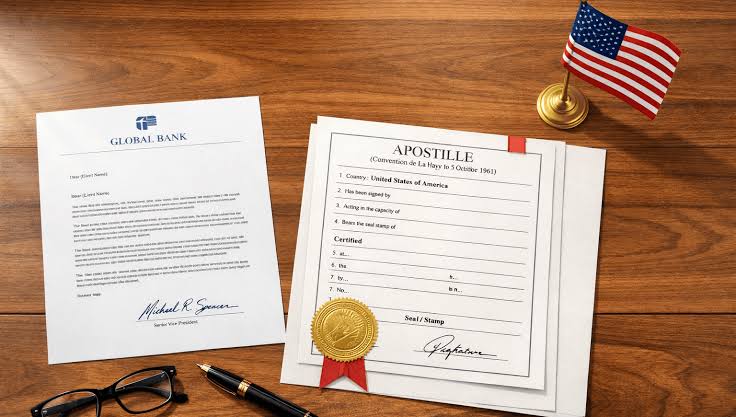
An apostille authenticates the signature and authority of the official who signed or notarized the document. If a Florida RON notary notarizes your affidavit or Power of Attorney, only the Florida Secretary of State can issue the apostille. You cannot submit a Florida notarization to California or New York for state authentication.
Federal vs. State Authority
State Secretaries of State cannot issue an apostille for federal documents such as FBI background checks, naturalization records, or federal court orders. These must be processed through the U.S. Department of State Office of Authentications in Washington, D.C. Furthermore, electronic FBI reports contain an embedded digital signature from a federal official; notarizing an FBI report through RON actually invalidates it for federal apostille processing.
Physical vs. Digital Acceptance Abroad
Even though RON creates a digital PDF with an electronic seal, many foreign authorities—especially local civil registries in Europe and Latin America—do not accept digital e-Apostilles. They often demand paper documents featuring physical seals, ribbon, or wet-ink signatures. It is critical to confirm the receiving country’s physical document requirements beforehand.
Using Florida RON for Cross-State Documents and Foreign Reciprocity
If you live in Madrid and need an apostilled Power of Attorney for California or a corporate resolution for a New York company, you do not need to hunt down a notary in those specific states. You can execute your document using Florida RON, provided the workflow follows proper legal principles.
Interstate Reciprocity and the Hague Convention
Under U.S. full faith and credit principles, legal documents formatted for California or New York can be validly executed anywhere if the notarization complies with the laws of the executing jurisdiction (Florida RON).
When the notarized document goes to Tallahassee, the Florida Department of State issues a Florida Apostille verifying the notary’s commission. Under the 1961 Hague Apostille Convention, member nations must accept an apostille issued by any competent state authority, regardless of which state’s laws govern the internal text of the document.
How to Format Out-of-State Documents Properly
- Power of Attorney Adjustments: When executing an out-of-state Power of Attorney via Florida RON, the notary must update the venue to “State of Florida, County of Hillsborough” (or the notary’s commissioning county) and attach a Florida-compliant Remote Online Notary Acknowledgment block. The Florida Department of State will then apostille the document smoothly.
- Corporate Records: If you need an apostilled corporate resolution for a New York or California entity, execute an Officer’s Affidavit by Document Custodian. You sign a sworn statement as a corporate officer attesting that the attached record is true and correct. The Florida notary completes a sworn Jurat via RON, making it instantly eligible for a Florida Apostille.
Real-Life Case Studies: Solving High-Stakes Emergencies Abroad
Case 1: The Expiring Background Check in Valencia
An American remote worker finalizing her Spanish Digital Nomad Visa in Valencia was three days away from her immigration appointment when officials flagged an un-notarized financial statement and demanded an apostilled Power of Attorney for her local lawyer.
U.S. Embassy notary appointments were booked out for weeks, and flying back to the U.S. would cost thousands and miss the visa deadline. Using Florida RON from her apartment, she verified her identity with her passport and signed her documents in 15 minutes. The notarized document was hand-carried for an expedited 24-hour state apostille. Within 36 hours, her lawyer submitted the apostilled package and locked in her Spanish residency.
Case 2: The Lisbon Real Estate Closing
A seller living in Portugal was closing on a $650,000 residential property in Austin, Texas. On closing morning, the title company rejected a deed signed at a local Portuguese notary because it lacked standard U.S. notary certificate language. Escrow was set to close at 5:00 PM EST, with a $500/day penalty hanging in the balance.
The seller joined an emergency RON video session from a café in Lisbon. The notary corrected the certificate language, executed the digital seal, and e-recorded the deed directly with the county clerk in Texas within hours. The sale closed on time without financial penalties.
Case 3: The Medellín Inheritance Freeze
Heirs in Colombia were attempting to unlock estate bank accounts belonging to their late father, a U.S. retiree. The Colombian bank required an apostilled Affidavit of Heirship and corporate authorizations for his Florida LLC. However, the heirs were non-U.S. citizens without Social Security Numbers or U.S. credit histories, blocking standard online identity checks.
Using AI-driven passport credential analysis and 3D liveness matching, the heirs verified their Colombian passports and completed a multi-party video RON session with a U.S. notary. The notarized affidavit was hand-delivered to the state capital for same-day apostille processing and shipped via express courier to Medellín, unlocking the estate in four business days instead of the estimated two-month diplomatic process.
Current Bottlenecks in International Authentication
While digital notarization has solved many problems, systemic delays across government agencies still create major headaches for overseas citizens:
- U.S. Embassy Scarcity: Citizen Services units at embassies across Latin America and Europe often have multi-week waiting lists for notary appointments. Travel costs and missed work make in-person embassy visits impractical for many expats.
- The Federal Apostille Backlog: The U.S. Department of State Office of Authentications in Washington, D.C., regularly takes 4 to 6 weeks to process federal apostilles by mail. When foreign immigration offices enforce 90-day validity windows on background checks, this federal backlog consumes half of your deadline.
- Inconsistent Local State Policies: Some county clerks still reject electronic notarizations on Letters of Authorization, demanding wet-ink signatures and raised paper seals. Additionally, state reliance on paper-only apostille processing forces digital RON documents back onto paper, adding unnecessary courier delays.
Pro-Tips Before Moving Abroad
If you are currently planning a move overseas, taking a few proactive steps before boarding your flight will prevent administrative emergencies later:
Execute a Gapping Power of Attorney
Never leave the country without granting a trusted family member, close attorney, or proxy a General Power of Attorney. Ensure the document explicitly grants authority to “request, retrieve, pay for, and collect certified public records, vital statistics, and government documents for international apostille and authentication purposes.” If an agency demands a physical walk-in, your state-side proxy can handle it immediately.
Order Fresh Long-Form Vital Records
Do not rely on old short-form birth cards. Order brand-new, Long-Form/Vault Certified Copies featuring raised seals directly from the issuing state or county vital statistics office as close to your departure date as possible to satisfy foreign 90-to-180-day recency rules.
Time Your FBI Background Check
If your visa requires an FBI background check, request your digital PDF through an approved FBI Channeler right before leaving. Submit it immediately for an expedited federal apostille via a walk-in courier service in Washington, D.C., rather than standard mail.
Maintain US Mobile and Financial Continuity
Port your U.S. phone number to a VoIP service that receives overseas SMS verification codes for two-factor authentication (2FA). Maintain at least one active U.S. bank account linked to a domestic mailing address to keep your identity footprint intact for remote verifications.
Prepare Academic Records at the Source
Before leaving, ask your school or university registrar to certify a true copy of your diploma or transcript in the presence of a local notary public. Once notarized by the school, the record can move straight to the Secretary of State for an apostille.
Strategy is Everything
Cross-border administrative emergencies rarely happen because a document does not exist; they happen because people use the wrong process, at the wrong level of government, under the wrong timeline. A notarization is only Step 1—an apostille validates the legal authority behind the seal.
Because vital records belong to their originating state, background checks belong to the federal government, and RON belongs to the commissioning notary’s state, navigating these jurisdictions requires a cohesive execution strategy. When working against strict visa windows or closing dates, eliminating trial-and-error delays is the only way to meet your deadline.
Don’t let a missing seal or bureaucratic misunderstanding derail your life abroad. Whether you are stranded overseas or prepping before departure, our team manages the entire authentication chain—from Remote Online Notarization to proxy retrieval and expedited apostilles—ensuring your documents are accepted the first time, anywhere in the world. Contact us today via WhatsApp or through our website to get started.