American expats often assume that being a U.S. citizen with an active domestic bank account guarantees seamless financial access. The truth is much harsher. U.S. financial institutions do not view American expats as valued global clients. They view them as high-risk, low-profit compliance liabilities.
Driven by the USA PATRIOT Act, Know Your Customer mandates, Anti-Money Laundering laws, and FATCA reporting, major retail banks would often rather freeze or close your account than manage the compliance overhead of an overseas resident. Trying to execute a routine Power of Attorney, wire transfer, or account update from abroad can quickly turn into a financial nightmare.
Navigating this system requires understanding how U.S. financial institutions operate, avoiding common international notarization traps, and deploying modern legal alternatives to protect your assets.
At Hillsborough Notary and Apostille, we have decades of international banking experience with 2 of the largest banks in the world. We have personally manned international trading desks in Europe and Latin America. We can attest that getting US Banking Documents notarized outside of the US can present multiple challenges.
The Biggest Misconceptions Facing Expats
The most frequent error expats make when managing banking paperwork abroad is assuming any notary stamp works if the document is stamped, or that a U.S. embassy is the only legal option. Both assumptions regularly lead to rejected documents, locked accounts, and missed transaction deadlines.
Civil Law Notarios vs. U.S. Notaries Public
In civil law countries like Spain, France, or Mexico, a notario is a high-level legal scholar who drafts contracts and verifies the substance of a document—not just identity. Standard U.S. bank forms carry a specific American notary block (an acknowledgment or jurat) governed by state laws. U.S. financial compliance teams routinely reject foreign notary stamps because they lack state-compliant wording and use foreign jurisdiction venue language.
Knowledge-Based Authentication Lockouts
Using a State Commissioned remote online notary allows Americans to notarize documents online from anywhere in the world before a U.S. notary. However, state-mandated RON platforms require Knowledge-Based Authentication (KBA). This involves answering dynamic, timed identity verification questions generated from U.S. credit bureaus. Expats who have lived abroad for years, have thin credit files, or froze their credit reports before moving frequently fail KBA, locking them out of online sessions.
Confusing Notarizations with Medallion Signature Guarantees
A Medallion Signature Guarantee is not a notarization. It is a financial indemnity stamp issued by a participating financial officer under specific transfer agent networks like STAMP. U.S. embassies, foreign civil notaries, and state-commissioned online notaries cannot provide a Medallion Signature Guarantee.
Case Study: Recovering a Blocked Closing in Valencia
An American expat living in Valencia, Spain, needed to execute an urgent Power of Attorney and Bank Account Authorization form allowing her brother to handle real estate closing documents and transfer funds in Florida. Following local advice, she visited a Spanish Notario Público, paid $150, and mailed the stamped paperwork directly to her bank’s legal department in the United States.
Three days before the property closing, the bank’s compliance team rejected the document. The foreign notary stamp lacked standard U.S. state notary wording, used a foreign venue, and lacked a Hague Apostille chain. With the U.S. Embassy in Madrid reporting a three-week waitlist for consular notary appointments, the entire property transaction was on the verge of collapsing.
The situation was resolved in under 24 hours through a direct, step-by-step recovery strategy:
- Conducted a Bank Legal Audit: We contacted the bank’s legal department to confirm their acceptance of Remote Online Notarization executed under state statutes by a commissioned U.S. RON notary.
- Pre-Screened Identity Requirements: We ensured the client unfreezed her U.S. credit file and utilized historical U.S. address data to clear the KBA security protocol.
- Executed a Compliant RON Session: The client connected over a secure audiovisual platform, digitally signed the paperwork, and received an immediate U.S. digital notary seal and audit log.
- Provided Direct Compliance Verification: The digital certificate and audit log were delivered to the bank’s underwriting team for immediate approval, saving the real estate closing without needing an embassy visit.
Overcoming Knowledge-Based Authentication Roadblocks Abroad
When living abroad, KBA systems often fail because data bureaus lack active public records to generate dynamic identity questions. There are actionable technical steps and statutory alternatives to bypass KBA lockouts:
- Unfreeze U.S. Credit Reports: Expats must issue a temporary “thaw” on their Equifax, Experian, and TransUnion accounts at least 24 to 48 hours prior to attempting an online notarization session.
- Input Historical U.S. Address Data: KBA algorithms pull from legacy U.S. public records. Enter the last valid residential U.S. address where you registered a vehicle, owned property, or filed taxes—never a foreign address or new virtual mailbox.
- Recognize Distractor Patterns: KBA quizzes intentionally insert distractor choices pulled from stranger records to prevent guessing. It is normal for two or three questions out of five to have “None of the Above” as the correct answer.
- Use Biometric Identity Proofing: Certain states and platform tools allow 3D facial liveness scans matched against the security features of an unexpired U.S. Passport, eliminating historical credit questions entirely.
- Utilize a Credible Identifying Witness: Under statutes such as Florida Statute § 117.265, if a signer cannot pass KBA, a notary can verify identity through a Credible Witness who can pass KBA and swears an oath on the recorded call.
How to Handle Bank Pushback and Embassy Mandates
Front-line bank representatives frequently insist, “We only accept wet-ink signatures stamped at a U.S. Embassy.” This response reflects internal branch training rather than federal law. Overcoming this friction requires bypassing branch staff and escalating the matter directly to the bank’s Legal, Risk, or Compliance Department.
Citing Federal and International Law
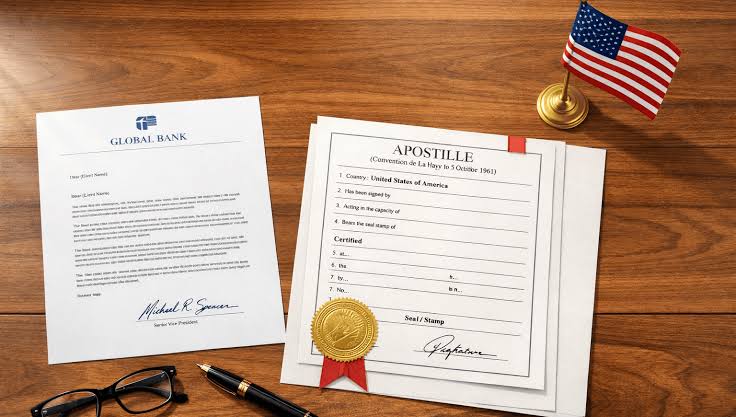
Under 22 CFR § 92.12 and the Hague Apostille Convention, a document notarized by a foreign civil notary and bearing an official Hague Apostille carries the same legal weight in the U.S. as a document notarized by an American official. Furthermore, federal law under 28 U.S.C. § 1746 allows unsworn written declarations executed outside the United States under penalty of perjury to substitute for formal notarized oaths on standard statements.
The Legal Exception Memorandum
To formally request an exception, provide the bank’s compliance department with a written statement:
TO: Bank Legal & Compliance Department
SUBJECT: Legal Execution of Financial Documents for U.S. Citizen Overseas – Account #[Number]
Dear Compliance Team,
I am currently residing abroad and require the execution of [Name of Form]. Due to multi-week wait times at the U.S. Embassy, securing a consular appointment within the required transaction timeframe is not possible.
To ensure full legal compliance under U.S. federal and state standards, I am proposing one of two legally binding alternatives:
- Remote Online Notarization (RON): Execution before a commissioned U.S. Notary Public via a state-sanctioned, secure audiovisual platform.
- Foreign Notarization with Hague Apostille: Execution before a local civil notary, accompanied by an official Hague Apostille certifying the notary’s credentials pursuant to 22 CFR § 92.12.
Please confirm which of these recognized options your risk team prefers so we may proceed immediately.
Non-Negotiable Rules for Loose Certificates
Attaching a U.S. loose certificate (an Acknowledgment or Jurat) to validate a foreign execution requires strict adherence to statutory rules. A single formatting error will trigger an instant rejection.
- Complete Statutory Wording: The certificate must explicitly state the state and county venue, the specific act (jurat or acknowledgment), the method of appearance (physical or online), and the specific identification verified.
- Strict Document Linking: Unlinked loose certificates are flagged for potential fraud. The certificate must feature a dedicated description block listing the title of the document, document date, total page count, and names of any additional signers.
- Proper Physical Attachment: Loose certificates must be placed immediately behind the signature page they certify and securely stapled along the upper-left margin.
- Avoiding the Venue-Jurisdiction Mismatch: The most common reason banks reject foreign notarizations is a contradictory venue. A U.S. state notary cannot claim venue in a foreign country for an in-person notarization. If the signing occurred overseas in person, the venue line cannot list a U.S. state and county without specifying Remote Online Notarization.
Managing Medallion Signature Guarantees and TreasuryDirect Forms
When an expat needs a Medallion Signature Guarantee or is executing federal forms like TreasuryDirect FS Form 5444, standard notarizations—including embassy notarizations—are flatly rejected.
Navigating Medallion Signature Requirements
Because a Medallion Signature Guarantee is a form of financial indemnity governed by transfer agent networks, you cannot obtain one from an online notary or a foreign civil notary.
- Request a Medallion Waiver: Ask the institution if they offer a Medallion Waiver Form for overseas accounts under specific dollar thresholds, or if they will accept an enhanced identity verification package combined with a standard notarization.
- Access International Branches of U.S. Banks: Major U.S. institutions participating in the STAMP program (such as Citi or Bank of America) maintain global wealth management branches in major overseas hubs like London, Frankfurt, or Tokyo that can provide Medallion stamps for existing account holders.
- Use SEC-Regulated Medallion Providers: Dedicated, specialized transfer facilitation firms allow verified overseas clients to complete digital identity verification and obtain official Medallion stamps remotely.
The Certifying Officer Trap on TreasuryDirect Forms
TreasuryDirect forms explicitly mandate signature certification by an authorized Certifying Officer at a financial institution using an official Signature Guarantee Stamp. Expats who mail forms notarized by standard notaries wait months only to receive rejection notices. If stuck abroad, request assistance from international banking branches or execute a state-specific Power of Attorney appointing a U.S.-based agent to manage the account locally.
Drafting Financial Powers of Attorney for Overseas Use
Generic Power of Attorney templates are almost always rejected by bank legal departments. To ensure an overseas financial Power of Attorney is accepted by a U.S. bank, it must contain specific statutory provisions:
- Express Grant of Banking Authority: Under Uniform Power of Attorney Acts, the POA must explicitly state powers to open, close, and modify accounts, initiate wire transfers, and access safe deposit boxes. If the agent needs to transfer funds to themselves, the document must include an explicit self-dealing clause.
- Explicit Durability Clause: The document must explicitly state that the agent’s authority continues uninterrupted if the principal becomes incapacitated.
- Governing Law and Venue: The document must state that it is governed by the laws of the specific U.S. state where the bank or account resides.
- Indemnity and Third-Party Reliance: An express clause holding the financial institution harmless for relying on the agent’s representations reassures bank risk departments.
- Witness Requirements: Financial POAs must be executed before two independent, disinterested witnesses who are not related to the principal, named as agents, or employed by the notary.
Strategies for Expediting Hague and Non-Hague Apostilles
Mailing paper documents back and forth across international borders creates massive delays. Streamlining the apostille process requires a clear execution strategy:
- The RON and Walk-In Strategy: Execute the document remotely with a commissioned U.S. online notary. The digital record can be submitted immediately to a specialized authentication team. Our Florida apostille service hand-delivers documents directly to the Secretary of State in Tallahassee, bypassing multi-week mail-in queues to secure processing in 24 to 72 hours.
- Pre-Audit Notarial Language: Verify that the notary seal is legible, the venue line is accurate, and a document description block is present before submission. A single clerical error will cause the state to reject the apostille request after weeks in queue.
- Navigating Non-Hague Destination Countries: If the destination country is not a member of the Hague Apostille Convention (such as the UAE, Qatar, or Kuwait), a standard Secretary of State Apostille will be rejected. Non-Hague countries require a multi-tiered legalization chain involving Secretary of State certification, U.S. Department of State authentication in Washington, D.C., and final consular legalization by the destination country’s embassy.
The Pre-Move Financial Checklist for Expats
The most effective way to protect your banking access overseas is to establish a robust domestic financial foundation before leaving the United States.
- Maintain a True U.S. Residential Address: Commercial Mail Receiving Agencies and virtual mailboxes are flagged by automated banking security systems. Maintain a legitimate U.S. physical residential address (such as a trusted family member’s home) for the bank’s internal primary address field, while listing your virtual mailbox or overseas address for mailing purposes.
- Execute a Durable Financial Power of Attorney: Appoint a trusted U.S.-based agent under a state-specific, durable financial POA before departing. If an account is frozen or requires an in-person bank visit, your agent can resolve the issue locally on your behalf.
- Secure a Real U.S. Mobile Line for 2FA: Many U.S. banks block foreign phone numbers and VoIP services from receiving Two-Factor Authentication security codes. Set up a low-cost, permanent U.S. mobile number using an eSIM that supports Wi-Fi Calling and international SMS.
- Maintain Expat-Friendly Backup Accounts: Never rely on a single financial institution. Maintain accounts across multiple institutions known for supporting international clients or offering multi-currency transfers to ensure you are never left without access to capital.
Navigating international document authentication, foreign notary rejections, and strict bank compliance mandates does not have to stall your financial affairs. At Hillsborough Notary and Apostille, we bring decades of direct experience in international banking combined with specialized certifications in Remote Online Notarization (RON) and Hague Apostille processing. Whether you need to execute a time-sensitive Power of Attorney, complete an online notary session from overseas, or hand-walk a document through state authentication, we ensure your paperwork is completed right the first time. Reach out to us today directly through WhatsApp or visit our website to schedule your consultation and get your international documents legally squared away.