Getting your child’s documents notarized for the school is no longer straightforward and simple
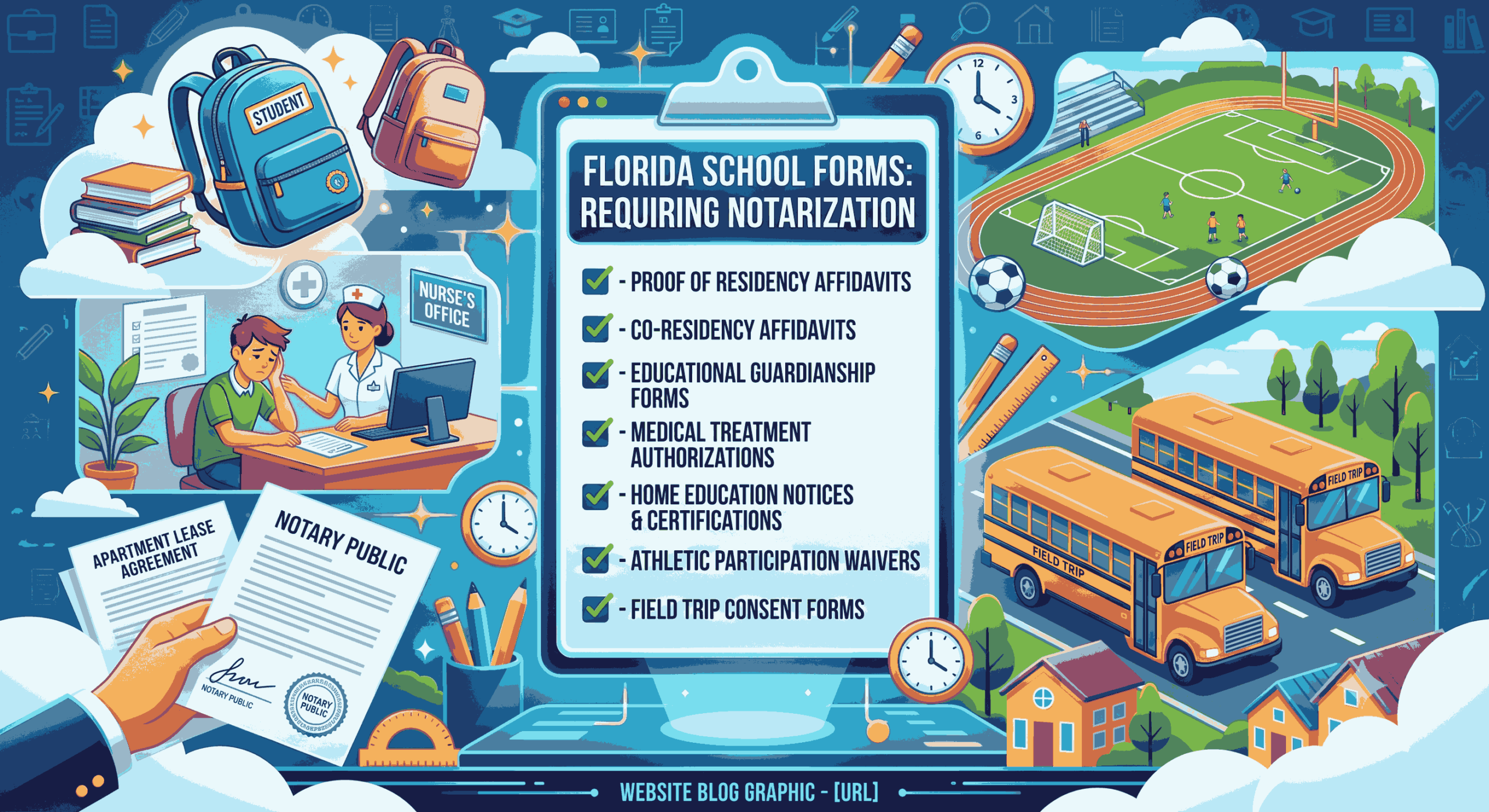
Florida school districts vary significantly in their requirements. For example, some counties require specific, notarized residency verification forms, while others rely heavily on notarized affidavits for student athletic participation, medical authorizations, or home education compliance. In my experience serving various Florida counties like Hillsborough, Pinellas, and Pasco, the theory of school board policy frequently crashes into the reality of legal notarization.
The Shared Residency or Co-Residency Affidavit
When a family moves in with a relative or friend—or hasn’t established a traditional lease yet—Florida school districts require a Shared Residence Affidavit to prove the child lives within the school zone. This document carries several hidden administrative hurdles.
First is the two-signer trap. Parents almost always show up to a notary alone. However, these forms typically require both the parent and the actual homeowner or leaseholder to sign. A notary cannot legally notarize a missing person’s signature.
This leads directly into the complication of split notarizations. If the homeowner and the parent cannot appear together, the form requires two separate notary blocks. When a school district template only has one block crammed at the bottom, it triggers massive confusion for generic signers about how to legally execute it for both parties.
Furthermore, parents often don’t realize that the homeowner must provide strict independent proof of residency, such as a property tax bill or mortgage statement, alongside the notarized form for the school board office to accept it.
FHSAA Athletic Compliance Forms
If a middle or high school student wants to play sports, the Florida High School Athletic Association (FHSAA) requires extensive compliance paperwork (such as the EL2 and EL3 forms). Certain variations—especially for home-schooled, private school, or charter school students crossing over to play for a public school team—require notarized signatures.
A major point of failure here is the student signature dilemma. The form requires both the parent and the student to sign in front of the notary. Parents routinely sign for their kids or leave the teenager at home, forcing a professional notary to turn them away.
Compounding this is the lack of identification for minors. Florida notary law has strict identification requirements. While a parent can easily produce a driver’s license, a 14-year-old athlete rarely has a state-issued photo ID. Parents often don’t know that the notary will need to rely on specific alternative identification methods, such as credentialed witnesses, to legally verify the minor’s identity.
Educational Guardianship and Power of Attorney
When a student lives with a grandparent, aunt, or family friend instead of their biological parent, school districts require a notarized Educational Guardianship Affidavit or a Limited Power of Attorney for Day-to-Day School Operations. This grants the caregiver the legal right to sign report cards, approve field trips, and make medical decisions at school.
Parents frequently leave sections blank, like the duration of the guardianship or specific medical authorities, because they are unsure of the details. Under Florida law, a notary should not notarize a document that contains blank spaces, as it leaves the form vulnerable to fraudulent alterations later.
Depending on how the district words its specific power of attorney form, it may also require two independent witnesses in addition to the notary. Parents rarely bring extra people to act as witnesses, causing an immediate halt to the process.
Last-Minute Scrambles and Downstream Disasters
Florida school enrollment and sports seasons operate on incredibly tight windows, especially right before the school year starts in August, or during mid-year transfers. When families wait until the last minute to get forms notarized, the downstream issues are severe.
When these forms are finally presented to the school, any small error causes the student to miss enrollment deadlines or get benched in sports. A minor administrative mistake on a form can literally stall a child’s education or athletic season because school data entry clerks are overwhelmed during the first weeks of the term. They will not accept a deficient legal document, and they do not have the time to help parents diagnose the issue.
Fixing Broken School Board Document Templates
Many out-of-state forms or poorly designed school district templates lack the legally mandated text required by Chapter 117 of the Florida Statutes. If a notary simply stamps a document without a legally complete notarial certificate, the notarization is invalid under Florida law. However, simply slapping a separate piece of paper on the back of a school form can cause an administrative clerk at the school board office to panic and reject it.
A precise, professional workflow ensures the document is legally unassailable while remaining clear enough for any school desk clerk to accept.
Diagnose the Deficiency
First, evaluate the existing notarial block against the nine statutory elements required by Florida law. The most frequent omissions on school forms include a missing venue (State of Florida, County of Hotspot), no indication of the specific notarial act performed (whether the signer was sworn for a jurat or acknowledged for an affidavit), missing text specifying whether the signer appeared via physical presence or online notarization, and missing check-boxes or text identifying the type of identification relied upon.
The Correction Over Rejection Method
A school board clerk likes to see everything on one page. Therefore, the first line of defense should be to keep the notarization on the original form if humanly possible.
If there is room, instead of using the broken pre-printed block, line through it completely, initial the line-through, and use a legally compliant Florida Jurat or Acknowledgment rubber stamp directly on the empty space of the document. This satisfies the law while keeping the entire transaction on the district’s original sheet of paper.
If there is absolutely no room, a loose notarial certificate must be attached.
Explicitly Link Loose Certificates
When a separate sheet is mandatory, it must be bound to the parent document so securely that a school clerk instantly understands they are one unified record.
Write directly on the school board form near the signer’s signature: “Notary certificate attached. See Page 2.” This prevents the school office from looking at the blank pre-printed block and thinking the form wasn’t notarized.
Fill out a loose certificate that features the exact wording from Florida Statutes. At the bottom of the loose certificate, fill out a strict document identification section. State the document name (such as the Hillsborough County Shared Residency Affidavit), the document date, the signer’s name, and the total page count. Mechanically bind the loose certificate as the final page using a staple in the upper-left corner. Never use paperclips, which allow pages to float or separate.
Some improperly trained individuals try to tie pages together by stamping their notary seal half on the school form and half on the loose certificate. Under Florida law, a seal must be full, distinct, and photographically reproducible. Splitting a seal compromises its legibility and violates best practices. Utilizing explicit text linking and document descriptors is the legally sound way to cross-reference multiple pages.
Navigating Identity Hurdles for Minors and Seniors
Florida has exceptionally strict identification laws for notarization, requiring a current, government-issued photo ID with a signature, or specific expired options if they were issued within the last 5 years. Minors playing high school sports rarely have a driver’s license, and in shared residency situations, the homeowner might be an elderly relative whose ID has recently expired. Florida law provides rigorous alternative pathways designed for exactly these situations.
The Credible Witness Framework
If a signer lacks acceptable ID, Florida law allows you to verify their identity through the sworn, written statements of Credible Witnesses. This is the most common path for high school athletes or housing-insecure parents.
You can use one credible witness if the witness is personally known to the notary and the witness personally knows the signer. Alternatively, you can use two credible witnesses if the notary does not personally know them. In this case, you must legally identify both witnesses using standard, valid government-issued photo IDs.
Under the statute, the notary must place the witnesses under oath, and they must swear or affirm to a strict five-part test: the signer is the person named in the document, the signer is personally known to the witnesses, the circumstances make it very difficult or impossible to obtain an acceptable form of ID, the signer does not possess any of the identification documents specified by Florida law, and the witnesses do not have a financial interest in and are not parties to the underlying transaction.
A parent cannot serve as a credible witness for their child if the parent is also a party signing the document, such as a Shared Residency Affidavit where both parent and student must sign. The witness must be a disinterested party, such as a neighbor, a family friend, or a school guidance counselor.
Hidden-in-Plain-Sight Statutory ID Alternatives
Before relying on credible witnesses, double-check if the parent or student possesses a less common but legally acceptable document. Florida law explicitly permits several forms of ID that parents often leave at home because they don’t realize they qualify, provided they are current or issued within the past 5 years and bear a serial or identifying number.
These include a foreign passport (stamped by the U.S. Department of Justice or the Bureau of Citizenship and Immigration Services), an inmate identification card issued by the Florida Department of Corrections (highly relevant if an educational guardianship is being established because a parent is incarcerated), a driver’s license or ID card issued by another U.S. state or territory, Canada, or Mexico, and a U.S. Military identification card.
Documenting the Pathway to Prevent Rejection
School enrollment clerks scan hundreds of forms a week. If they see a form that says “Produced ID: ” and a notary has written “Credible Witnesses” in the blank, the clerk may assume the form is incomplete and reject it.
To bridge the gap between strict notary compliance and school board bureaucracy, execute a separate Sworn Written Statement of Credible Witness form. Do not just write a note on the school form. Complete a formal affidavit for the witnesses to sign, explicitly listing the five statutory conditions, and notarize the witness signatures on this separate affidavit.
On the main school board form’s notarial certificate, fill out the identification section with absolute clarity so the school clerk understands the legal chain of custody by checking “Produced Identification” and specifying the use of sworn written statements of credible witnesses with the attached affidavits. Finally, staple the Credible Witness affidavits directly behind the primary school board form.
Form DH 681: The High-Stakes Immunization Exemption
The Florida Department of Health Form DH 681 (Religious Exemption from Immunization) is arguably the most tightly regulated, high-stakes document a parent will encounter during school registration. Because Florida does not allow personal or philosophical exemptions, the State treats DH 681 with an extreme level of administrative scrutiny.
Executing a Flawless Jurat
Form DH 681 is not a simple acknowledgment of a signature; it is a sworn affidavit. This dictates specific legal requirements that cannot be bypassed.
The parent must verbally swear or affirm that the statement on the form matches their bona fide religious tenets. A notary cannot just quietly stamp the paper. The notary must administer a formal, verbal oath.
The custodial parent or legal guardian must physically stand before the notary. A spouse or relative cannot bring the form on the parent’s behalf.
Furthermore, county health offices print these forms directly out of the Florida SHOTS registry system. Frequently, the pre-printed notary block at the bottom is significantly outdated under modern Florida statutes, often lacking the mandatory text regarding physical versus online presence or the specific ID type required. If the printed block is legally deficient, it must be lined through, initialed, and corrected with a compliant Florida Jurat stamp or a securely stapled loose certificate.
Department of Health Gatekeeping and Hidden Pitfalls
The process of getting the form before it even reaches a notary is where most parents experience massive delays. You cannot download DH 681 from the state website; it is printed on-demand exclusively at local Florida Department of Health county clinics.
Many county health departments will not let a parent leave the clinic with a blank DH 681 form to find an outside notary. Because the Department of Health employs staff members who hold notary commissions, their internal policy is usually to require the parents to sign it and have it notarized right there at the clinic window.
If a parent plans to use a trusted mobile notary, they must explicitly ask the clerk if they are permitted to take the unexecuted paper to an outside notary. Some counties strictly refuse to hand the paper across the glass unless it is executed on-site.
To even generate the form from the Florida SHOTS system, parents must present the child’s official birth certificate, a valid government-issued parent photo ID, and the child’s complete existing immunization and health records to register them in the state database first.
The August Deadline Pressure and Hard Exclusion
Florida law requires a valid immunization record or an exemption form prior to entry, attendance, or transfer. While out-of-state transfer students or homeless youth are occasionally granted a temporary waiver, local students without a flawlessly completed DH 681 on Day One will face a hard exclusion, meaning they will be pulled out of class and barred from school until the paperwork is perfectly corrected. Securing specialized Florida family notarization services from a professional who understands how to navigate these rigid frameworks is the ultimate insurance policy for protecting your child’s school year.
Don’t let a paperwork error disrupt your child’s education.
Book our specialized Florida family notarization services today to ensure your school board forms, athletic compliance documents, and DH 681 exemptions are executed flawlessly the first time.