
Florida Corporate Notary & Commercial Legal Execution Services
Precision Executive Signing, Commercial Loan Closings, International Legalization, & Enterprise Compliance Across West Central Florida & Worldwide via RON.
- PMP-Managed Coordination
- Certified Loan Signing Agents
- Enterprise RON from $95
- Guaranteed 2-Hour Mobilization

Executive Overview & Authority Standard
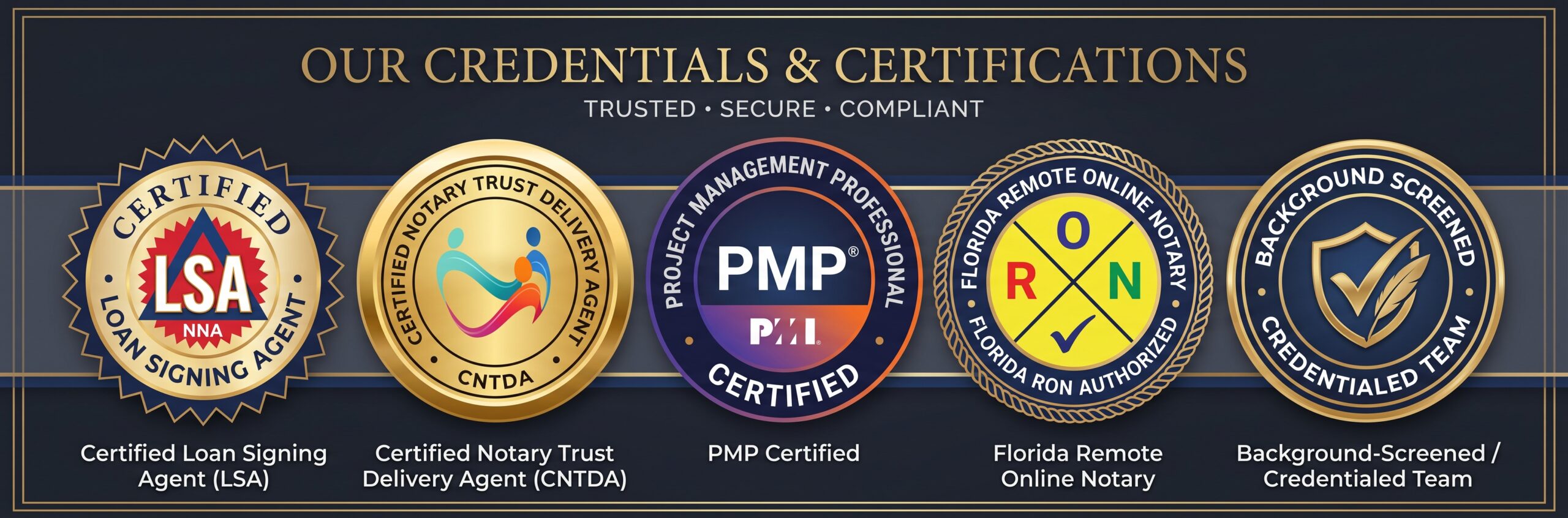
When executing high-stakes transactions, corporate governance instruments, and international filings, standard notary services present operational risk. Hillsborough Notary & Apostille delivers enterprise-grade notary coordination led by certified Project Management Professionals (PMP), veteran banking officers, and former Clerk of the Circuit Court experts.
Whether coordinating multi-signatory commercial financing packages, executing board resolutions under strict C-suite calendar constraints, or authenticating corporate charters for international expansion, we ensure 100% statutory compliance under Florida Statute Chapter 117, strict title underwriter adherence, and zero post-closing clouding.
- 100% statutory compliance under Florida Statute Chapter 117
- Strict title underwriter adherence
- Zero post-closing clouding
Certified Project Management Professionals (PMP)
Enterprise-grade notary coordination, project-managed from dispatch to recording.
Veteran Banking Officers
Multi-signatory commercial financing packages handled with institutional discipline.
Former Clerk of the Circuit Court Experts
Recording requirements, land records and court filings understood from the inside.
Why Corporations Choose Hillsborough Notary
Comparing standard retail notary dispatches against our PMP-managed, high-security corporate signing coordination.
Staffing & Vetting Standards
Unvetted general public notaries; basic state commission only.
- 100% Pre-Screened, Credentialed Notaries & Disinterested Witnesses
Corporate Governance Pre-Audit
None; stamps documents without verifying officer authority or Sunbiz status.
- Sunbiz Incumbency & Representative Capacity Cross-Matching
Commercial Loan & Title Compliance
Frequent certificate errors leading to title clouding or rejected lender packages.
- Certified Loan Signing Agents (500+ Closings) & Underwriter Alignment
Remote Online Notarization (RON)
Consumer portals lacking audit logs or statutory retention compliance.
- Enterprise RON ($95 Base) with Biometric KBA & 10-Year Vault Retention
International Legalization (Apostille)
Standard mail submission with 3-6 week state processing delays.
- Direct Tallahassee Hand-Carry Courier (3-Day & 8-Hour Express)
Estate & Trust Presentation Deliverables
Basic loose pages clipped together; no witness coordination.
- CNTDA White-Glove Binder Packages ($100) & Recorded Filings ($60)
Response Time & Executive Dispatch
Standard 9-to-5 office windows; non-flexible scheduling.
- Guaranteed 2-Hour On-Site Mobilization & Board Session Holding
Corporate & Commercial Services Portfolio
Jump to any pillar below. Each one covers the execution format, the statutory standard we work to, and the deliverables your team receives.
- 1. Corporate Governance & Entity Administration
- 2. Commercial Real Estate & Finance (Loan Signing)
- 3. International Business & Legal Authentication (Apostille & Embassy Legalization)
- 4. Remote Online Notarization (RON) & Digital Signings
- 5. Human Resources & Workforce Compliance
- 6. Estate Planning & Trust Delivery Coordination
- 7. Mobile, On-Site & Concierge Signing Coordination
Corporate Governance & Entity Administration
Corporate governance notarization is the formal verification of corporate officers’ identities, representative capacity, and legal authority prior to executing foundational business filings, organizational restructures, or Division of Corporations submissions.
Hillsborough Notary provides dedicated support for secretarial teams, general counsel, and corporate officers:
- Entity Formation & Foundational Instruments: Verification of officer signatures and legal authority on Articles of Incorporation, Articles of Organization, Bylaws, Operating Agreements, and shareholder agreements prior to Sunbiz submission.
- Board & Managing Member Action Verification: Execution of board resolutions, banking resolutions, corporate borrowing authorizations, consent orders, and certified board meeting minutes.
- Foreign Qualification & Incumbency: Authenticating Certificates of Authority, Incumbency Certificates, and representative capacity to ensure executing officers possess legal authority to bind the entity.
- Regulatory Filings & Entity Restructures: Notarizing sworn officer declarations for Beneficial Ownership Information (BOI) reporting, Articles of Dissolution, merger agreements, and affidavits of lost stock certificates.
- Executive Turnaround & Session Holding: Tailored high-discretion scheduling including 24/7/365 after-hours mobilization, on-site board meeting "session holding" for live execution upon board vote, and distributed multi-party execution blocks.
Commercial Real Estate & Finance (Loan Signing)
Commercial loan signing coordination involves the pre-audit of officer capacity, execution of complex commercial security instruments, and title underwriter compliance verification for high-value real property and asset-backed transactions.
Backed by experience across over 1000 real estate transactions, our Certified Loan Signing Agents (LSA) streamline commercial closings at law firms, lender offices, title companies, or corporate headquarters:
- Representative Capacity & Title Cross-Matching: Pre-closing audits cross-referencing officer titles with Sunbiz records, LLC operating agreements, and borrowing resolutions to ensure notarial certificate verbiage strictly matches lender overlays and F.S. § 117.05.
- Multi-Party & Distributed Executions: Concurrent Remote Online Notarization (RON) digital execution rooms for multi-state board members, paired with parallel background-screened mobile signing dispatches for multi-location wet-ink signings.
- Title Underwriter Compliance (F.S. Ch. 117 Part II): Complete compliance with Fidelity, First American, and Old Republic mandates, including two-minute Knowledge-Based Authentication (KBA), cryptographic ID analysis, tamper-evident digital seals, and secure 10-year audio-video recording retention.
- Gap Coverage & Corrective Speed: Same-day execution and immediate courier dispatch of physical deeds and commercial mortgages to county clerks to eliminate the title gap period prior to recording.
International Business & Legal Authentication (Apostille & Embassy Legalization)
Corporate apostille and legalization is the legal chain-of-authentication process required to validate Florida corporate documents, powers of attorney, and good standing certificates for legal recognition in foreign jurisdictions.
As Certified Apostille Agents, we facilitate international corporate transactions, subsidiary expansion, and foreign litigation filings:
- Hague Convention Apostilles: Obtaining expedited Apostilles through the Florida Department of State in Tallahassee for Hague member countries.
- Non-Hague Embassy Legalization: Navigating complex multi-tier authentication chains through the U.S. Department of State in Washington, D.C., and foreign embassies/consulates.
- Corporate Charter & Foreign Good Standing: Authenticating certified corporate charters, articles of amendment, officer powers of attorney, and board resolutions for foreign registration.
- Turnaround Tiers: Standard processing, expedited 3-business-day direct courier hand-carry intake at Tallahassee state offices, and 8-business-hour urgent processing for eligible corporate filings.
Remote Online Notarization (RON) & Digital Signings
Corporate Remote Online Notarization (RON) allows executive signers to legally execute audio-video notarized digital documents from anywhere in the world using secure biometric credentialing and tamper-evident digital signatures.
We provide seamless, cross-border digital signing sessions starting at $95:
- Pre-Screened & Credentialed Execution Teams: Every RON session is managed by fully vetted, background-screened, and credentialed Florida Remote Online Notaries to guarantee legal enforceability and title compliance.
- Executive Global Access: Secure digital execution sessions accessible to remote executives, overseas parent company officers, and multi-state joint venture partners.
- Enterprise Platform Deployment: Deploying secure, state-approved platforms (including Proof and BlueNotary) featuring enterprise-grade identity proofing (KBA and passport/ID cryptographic analysis).
- Cross-Border Authentications: Executing foreign entity powers of attorney, commercial closing packages, and digital corporate affidavits with automated audit trailing and instant downloadable certificate distribution.
Human Resources & Workforce Compliance
HR notary compliance encompasses Authorized Representative services for Form I-9 verification, executive agreement attestations, and corporate workforce onboarding.
We partner with enterprise HR departments, recruiters, and corporate legal teams to ensure workforce compliance across physical and remote operations:
- Form I-9 Authorized Representative Services: In-person and digital verification of Section 2 identity and employment authorization documents for remote and hybrid employees.
- Bulk Onboarding & Site Visits: Dispatching mobile notary teams to corporate sites, job fairs, or enterprise offices for synchronized multi-employee onboarding sessions.
- Executive HR Agreements: Mobile and digital execution of executive employment agreements, restrictive covenants, non-disclosure agreements, and severance documentation.
Estate Planning & Trust Delivery Coordination
Trust delivery coordination involves the white-glove presentation, execution, witnessing, and filing of high-net-worth estate planning instruments, executive trusts, and asset transfer deeds.
We partner directly with estate planning attorneys, private wealth advisors, and family offices to provide flawless, client-facing execution packages starting at $235:
- Vetted Notaries & Disinterested Witnesses: All assigned notaries and accompanying witnesses are pre-screened, background-checked, and credentialed to ensure compliance with strict Florida execution requirements for wills, trusts, and healthcare directives.
- White-Glove Presentation Services: Complete execution packages presented in custom estate binders ($100 presentation service fee) with structured document ordering, ribbon presentation, and professional tab indexing.
- Full In-Office & Mobile Teams: Providing complete notary and disinterested witness teams directly to law offices, private wealth suites, family offices, or client residences.
- Document Recording & Asset Transfers: Expedited county recording services ($60 recording coordination fee) for real property deeds transferring assets into family trusts or corporate entities.
Mobile, On-Site & Concierge Signing Coordination
Concierge mobile notarization provides rapid-response, on-location legal document execution at corporate headquarters, financial institutions, private hangars, and healthcare facilities.
Serving West Central Florida—including Hillsborough, Pinellas, Pasco, and Polk counties:
- Rapid 2-Hour Mobilization: Guaranteed rapid dispatch to corporate suites, law offices, airport lounges, or private residences based on operational scheduling.
- Discreet Executive Service: High-privacy execution protocols for C-suite officers, high-profile individuals, and sensitive commercial negotiations.
- Secure Courier Dispatch: Immediate post-execution courier transfer to local county courthouses, title underwriters, shipping hubs, or regional airports.
Corporate Compliance & Service Matrix
Cross-referencing execution formats, statutory compliance benchmarks, and turnaround times across all seven business notary pillars.
1. Corporate Governance & Entity Admin
F.S. § 117.05 Representative Capacity; Sunbiz Officer Incumbency Cross-Match
- Same-Day / Live Board Session Holding
2. Commercial Real Estate & Loan Signings
Fidelity / First American Underwriter Audits; Pre-Closing Capacity Pre-Audit
- Same-Day / Gap-Free Courier Recording
3. International Legalization & Apostille
Hague Convention Protocols; US Dept of State Multi-Tier Chain Authentication
- 8-Hr Express / 3-Day Hand-Carry
4. Remote Online Notarization (RON)
F.S. Ch. 117 Part II; Biometric KBA; Cryptographic ID Analysis; 10-Yr Vault Retention
- On-Demand (Starting at $95)
5. Human Resources & Workforce Compliance
USCIS Authorized Representative Mandates; Section 2 Form I-9 Verification
- Scheduled Bulk Onboarding
6. Estate Planning & Trust Delivery
Certified Notary Trust Delivery Agent (CNTDA) White-Glove Presentation Standards
- Packages Start at $235
7. Mobile Concierge Signing Coordination
Background-Screened / Credentialed Team; Strict C-Suite Discretion Protocols
- Guaranteed 2-Hour Mobilization
Corporate Notary Questions, Answered
Twenty questions general counsel, title officers and corporate secretaries ask us most, grouped by topic. Each one explains why it matters before giving the answer.
Authority, Capacity & Entity Verification
01How does a notary verify the legal authority of an executive or managing member to sign on behalf of an LLC or Corporation?
Why this matters: Institutional lenders, title underwriters, and state agencies will reject a corporate transaction if an individual executes a contract without documented authority to bind the entity.
Answer: A notary verifies signer identity via government ID, but verifying legal representative capacity (e.g., President, Managing Member) involves reviewing underlying authority documents provided by the entity. This includes Sunbiz (Florida Division of Corporations) manager/officer listings, corporate bylaws, operating agreements, or formal board resolutions. When performing an acknowledgment in a representative capacity, Florida law requires the notary to specify both the signer’s name and their specific corporate title in the certificate block.
02Can a Florida notary draft or alter an Incumbency Certificate or Corporate Resolution during the signing session?
Why this matters: Altering governance language or selecting legal forms without authorization exposes the transaction to legal challenges and constitutes the Unlicensed Practice of Law (UPL).
Answer: No. Florida non-attorney notaries are strictly prohibited from drafting, editing, or advising on the language of corporate resolutions or incumbency certificates. The notary may only complete the formal notarial certificate (acknowledgment or oath) attached to the document. Any modifications to the substantive document text must be made by corporate legal counsel or the entity’s authorized officers prior to execution.
03What happens if a corporate officer's title on Sunbiz does not exactly match the signature block on commercial financing or conveyance documents?
Why this matters: Minor title mismatches between public state records and transaction documents can cause county recording rejections or title insurance coverage exceptions.
Answer: Discrepancies (e.g., listed as “Manager” on Sunbiz but signing as “Chief Executive Officer”) flag potential authorization defects. Notaries resolve this by cross-referencing internal governance records (such as an internal resolution or incumbency certificate confirming the dual title) or requesting that corporate counsel update the document signature blocks or Sunbiz filings before notarization to maintain complete consistency across the record.
04Does an Out-of-State Foreign Entity need a Florida-specific notarial certificate when executing corporate agreements within Florida?
Why this matters: Executing out-of-state corporate documents within Florida without conforming to local statutory notarization rules can invalidate the notary block for Florida recordation.
Answer: If the document is being notarized physically within Florida, the notary must use a certificate format that complies with Florida Statutes (F.S. § 117.05), including state/county venue and required statutory elements. Even if the underlying contract is governed by Delaware or New York law, the notary block reflects where the notarial act occurs.
Remote Online Notarization (RON) & C-Suite Execution
05Can distributed board members located in different states or countries join a single Remote Online Notarization (RON) session to execute board consents?
Why this matters: Enterprise board members often reside in multiple time zones, making physical gatherings impractical for time-sensitive corporate votes or capital raises.
Answer: Yes. Florida’s RON statute (F.S. Chapter 117, Part II) permits a Florida-commissioned online notary to host multi-signer digital sessions. Board members can join the secure audio-video session concurrently from anywhere in the world, verify their identities digitally, and execute a single electronic document.
06Will major title underwriters and institutional commercial lenders accept Florida RON for multi-million-dollar corporate real estate closings?
Why this matters: Using RON without prior underwriter clearance can stall funding or prevent a commercial loan from closing.
Answer: Major title underwriters (e.g., Fidelity, First American, Old Republic) and commercial lenders accept Florida RON, provided the session strictly adheres to statutory identity proofing—specifically Knowledge-Based Authentication (KBA) and credential analysis—and the audiovisual session is recorded and retained for the mandated 10-year period. Pre-approval from the specific underwriter or lender is verified prior to the session.
07How are foreign corporate executives without a U.S. Social Security Number or U.S. credit history verified for a Florida RON session?
Why this matters: Standard RON identity verification relies on U.S. credit history for KBA questions, which blocks non-U.S. executives from completing automated checks.
Answer: Under Florida law, foreign signers without U.S. credit history can be verified through credential analysis of an unexpired foreign passport alongside biometric identity verification protocols built into modern RON platforms. Alternatively, the identity can be established via two remote digital witnesses or a digital identity proofing method compliant with F.S. § 117.265.
08Is an enterprise RON platform secure enough to handle confidential M&A, intellectual property transfers, or unannounced corporate actions?
Why this matters: Executing high-stakes corporate transactions online introduces risks regarding data leaks, market manipulation, or unauthorized access to material non-public information.
Answer: Approved enterprise RON platforms utilize end-to-end SOC 2 Type II compliance, AES-256 encryption for data at rest and in transit, and tamper-evident digital seals (PKI technology). Access to documents and session recordings is strictly restricted to authorized participants and compliance administrators.
International Business, Apostilles & Legalization
09How do we get an Apostille for Florida corporate documents (e.g., Good Standing Certificates, Articles of Incorporation) for foreign subsidiary operations?
Why this matters: Foreign governments and overseas regulatory bodies require authenticated corporate records before permitting a Florida business to open foreign offices, bank accounts, or subsidiaries.
Answer: Corporate records issued by the Florida Department of State (Division of Corporations) are submitted directly to the Secretary of State’s Division of Corporations in Tallahassee. The state verifies the seal and signature of the issuing official or notarizing agent and attaches an official Hague Convention Apostille certificate.
10What is the difference between standard state mail-in apostille processing and expedited corporate hand-carry services?
Why this matters: Standard state mail processing can take 4 to 6 weeks, creating unacceptable delays for international commercial deals.
Answer: Standard processing relies on standard postal mail queues at state offices. Direct hand-carry services utilize designated professional couriers or agents who physically present documents directly to state intake windows in Tallahassee, reducing turnaround times down to 24–72 hours for urgent international filings.
11Do corporate documents going to Non-Hague Convention countries require extra steps beyond a Florida Apostille?
Why this matters: Submitting an Apostille to a non-signatory country results in immediate legal rejection by foreign courts and administrative bodies.
Answer: Yes. Non-Hague countries require “Chain Authentication.” The document is first certified by the Florida Secretary of State, then authenticated by the U.S. Department of State in Washington, D.C. and finally legalized by the target country’s embassy or consulate.
12When is a Florida Civil Law Notary required instead of a standard Notary Public for international corporate transactions?
Why this matters: Standard common-law notarizations are often rejected in civil-law jurisdictions (e.g., Latin America, Continental Europe) due to differences in legal notary authority.
Answer: A Florida Civil Law Notary (appointed under Chapter 118, Florida Statutes) is an experienced Florida attorney authorized to issue authentic acts, legal conclusions, and certified instruments. They are used when foreign corporate transactions require the notary to state legal findings or authenticate transactions beyond basic identity verification.
Operations, Scheduling & Corporate Risk Management
13Can a mobile notary meet executives at non-traditional locations, such as private airport hangars, board retreats, or closing war rooms?
Why this matters: C-suite calendars and urgent transaction timelines rarely fit within standard office hours or static locations.
Answer: Yes. Executive mobile notary specialists operate on 24/7/365 dispatch models, traveling directly to private terminals, boardrooms, off-site retreats, or closing rooms equipped with mobile printing, scanning, and secure document handling capabilities.
14Can an employee-notary (in-house corporate notary) notarize documents for their own employer or parent company?
Why this matters: Invalid notarizations caused by employee conflicts of interest can void corporate deeds, financing agreements, or court filings.
Answer: Yes, under F.S. § 117.107(12), an employee may notarize signatures for their employer. Florida law explicitly clarifies that standard salary or employment status does not constitute a prohibited “financial interest” in the transaction, provided the notary is not personally named in the document and receives no direct commission or transaction-based compensation from the deal.
15If an employer pays for an employee's notary commission, who owns the notary stamp and journal if the employee leaves?
Why this matters: Employers often mistakenly assume corporate ownership of notary seals, leading to illegal retention of official tools.
Answer: Under Florida law, the notary commission, official seal (stamp), and notary log/journal belong strictly to the individual notary public, regardless of who paid for the commission, supplies, or bond. The employer cannot seize or retain the seal or journal upon the employee’s departure.
16How does a business handle bulk or high-volume notary executions (e.g., hundreds of lien waivers, shareholder notices, or fleet title transfers)?
Why this matters: Unstructured bulk signings cause bottlenecked administrative workflows and increased error rates.
Answer: Hillsborough Notary handles high-volume executions are managed by scheduling dedicated on-site signing sessions, setting up batch RON workflows, or engaging a retained signing agent service. Modern execution involves pre-auditing document templates, setting up automated signature fields, and using dedicated multi-notary teams.
Compliance, Retainers & Liability
17Does Hillsborough Notary offer retainer agreements or monthly billing for law firms and corporate legal departments?
Why this matters: One-off credit card reimbursements create significant accounting friction for high-volume legal and corporate secretarial teams.
Answer: Yes. Professional agencies like Hillsborough Notary structure dedicated retainer tiers or centralized monthly invoicing. Billed accounts include client-matter tracking codes, guaranteed Service Level Agreements (SLAs) for emergency dispatches, and preferred volume rates.
18What level of Errors & Omissions (E&O) insurance should a notary provider hold to handle high-value corporate deals?
Why this matters: Florida only mandates a $10,000 state notary bond, which provides zero liability protection to the client in major commercial transactions.
Answer: Executive signing specialists and corporate notary firms carry commercial-grade Errors & Omissions (E&O) insurance policies ranging from $1,000,000 to $2,000,000 to cover potential administrative or procedural errors on high-value transactions.
19How are statutory notary fee caps reconciled with travel, concierge, and after-hours service charges on corporate invoices?
Why this matters: Unclear invoicing that mixes statutory notarization fees with travel charges risks violating statutory fee limits under F.S. § 117.05.
Answer: Florida caps statutory notarial act fees at $10 per execution ($25 for RON base acts). On corporate invoices, the statutory notarial fee is itemized separately from non-notarial charges such as travel, holding time, document printing, courier hand-carry, or after-hours concierge dispatch.
20What happens if a notary error delays a major closing or causes a county recording rejection?
Why this matters: Filing rejections during tight closing windows jeopardize funding commitments and create title gap liabilities.
Answer: Established providers like Hillsborough Notary maintain emergency post-closing re-execution protocols. This includes immediate dispatch (in-person or via instant RON) to correct notary block errors, re-sign omitted pages, and coordinate hand-delivery to county recording offices or title underwriters at no additional charge.
Dispatch a Corporate Notary Team
Serving West Central Florida, including Hillsborough, Pinellas, Pasco, and Polk counties, with guaranteed 2-hour mobilization and worldwide Remote Online Notarization (RON) starting at $95.
